Monday, February 24, 2014

7 Lessons from "Like a Broken Vessel" by Elder Holland

Yesterday in Relief Society, we had an amazing lesson. We discussed Elder Holland's talk "Like a Broken Vessel". Whether you are LDS or not, this is an inspiring talk that everybody can relate to. He discusses having hope when mental illness strikes, mainly depression. Elder Holland talks with such power and love, that you can't help but be moved by his testimony and the spirit. 

As sisters we discussed and shared experiences relating to depression and his talk. The spirit was so strong, it moved many of the sisters to tears. This can be a sensitive topic. Emotions were strong and love for our Savor filled the room. 

I'd like to share some of the highlights of his talk and add my own reflections. I've never suffered from depression or any other from of mental illness, but someone very close to me does suffer from a mental illness. Whether you are the the one suffering or the caregiver of such, I know you can find comfort and hope in this short talk. 

How can we keep hope during dark and troubling times when mental illnesses such as depression strike? Elder Holland gives us some guidance in his talk.


1. God gave us a Redeemer, that we might triumph over the tests and trials of this mortal life. Elder Holland reminds us that we are living in a fallen world, and that we did in fact, choose to live in this fallen world. It is here where pursuit of godliness "will be tested and tried again and again." 
"Of greatest assurance in God's plan is that of a Savor was promised, a Redeemer, who through our faith in Him would lift us triumphantly over those tests and trials, even though the cost to do so would be unfathomable for bot the Father who sent Him and the Son who came. It is only an appreciation of this divine love that will make our own lesser suffering first bearable, then understandable, and finally redemptive." - Elder Holland

2. Above all, never lose faith in your Father in Heaven, who loves you more than you can comprehend. Elder Holland quotes President Monson in saying:
That love never changes...It is the there for you when you are sad or happy, discouraged or hopeful. God's love is there for you whether or not you feel you deserve [it]. It is simply always there".
Elder Holland admonishes us to never doubt God's love for us and never harden our hearts toward Him.

3. Faithfully pursue the time-tested devotional practices that bring the Spirit of the Lord into your life. Do the things that bring the spirit into your life. It is by the strength of God that we pull through hard times. Draw closer to him. Pray, read your scriptures, partake of the sacrament, and attend the temple if possible.

4. Seek the counsel of those who hold keys for your spiritual well-being. Ask for and cherish priesthood blessings. I know that in the hardest times of my life, priesthood blessings have brought incredible strength to a weary soul. I've learned that you do not have to be on your deathbed to have enough reason to ask for a blessing. God wants us to turn to him, he wants to bless us. This is why he has given the priesthood to worthy men. He uses these worthy men to pronounce blessings upon our heads and to give us guidance, comfort, strength and courage.
     If you do not have a husband or family member who is capable of giving you a priesthood blessing, there are home teachers, bishops, ward members, and missionaries who can give blessings if asked. There is always this resource available.

5. If capable, take the sacrament every week. I know that when there are prolonged periods where I have missed the sacrament for one reason or another, that I can feel my spirit shrink and weaken. There is great strength in the sacrament. Whenever I partake of the sacrament, my strength and faith is renewed. It is a time when we reflect on the Atonement of our Lord and Savior, Jesus Christ. It is through him we receive strength to carry on and one day, make it back to our Father in Heaven.

6. Believe in miracles. Elder Holland said "I have seen so many of them come when every other indication would say that hope was lost. Hope is never lost." I too, have seen miracles in my own life. When it seems like there is no light at the end of the tunnel, when we think the sun will never shine again, by our faith it will. The light will come. I echo the words of Elder Holland, Hope is never lost.

7. If things continue, seek advice. If things persist, "seek the advice of reputable people with certified training, professional skills, and good values." He encourages us to be honest with them about the struggles we've been facing, then pray about the advice they've given.

There are some of us, while we may not be suffering from an illness, we are caregivers to someone who is. I fit more into this category. Elder Holland's words can give us strength. Let us not be overwhelmed and let us not assume we can fix everything. I believe and know that sometimes the person with mental illness such as depression, bipolar or schizophrenia is not the only one who is to learn and grow from their situation. It's those around, the caregiver, the passerby-er, a friend or acquaintance who are to learn and grow from the situation as well.

A family member who is dear to my husband and I suffers from schizophrenia. This can be very hard to see, most times, there is nothing we can do. But, we always learn vastly important lessons that will carry on with us through our life. Love always, cherish the moments together, etc. Our challenges will only help us in the future, in ways we cannot know right now. How much more will we be able to relate and help another, because of the trials of our past? How much easier will it be for us to place an arm around a shoulder and comfort someone in need? We came to earth to grow, to learn and to be tested. Growth does not come by gliding through life. Growth comes from trials and challenges. Let us be strong and have faith during these times, because God will not give us a commandment, trial or challenge that we cannot keep, overcome or endure.  As Elder Holland said "We are infinitely more than our limitations or afflictions!".

I hope that if you are struggling, or know someone who is, listen to the words of one of God's apostles and may it give you strength and courage to continue on and endure. I invite you to take a few minutes and listen to Elder Holland as he delivers his powerful message titled "Like a Broken Vessel" May it help and God bless you.


- SamiMae

Sunday, February 23, 2014

9+1 Awesome Perks of Being Married - Especially (But Not Solely) for Mormons.

I love being married. Can I just say? It's great.

Not only is being married superlatively rewarding, but being married and Mormon is even better. Our theology of the family is so robust, it takes an institution that has already been the backbone of most civilizations for millennia, and takes it to a whole new level. I have found that Paul was truly wise when he said in Hebrews (13:4) that “marriage is honorable in all.”

I want to share, then, a few of the things that I have personally lived over these last six-plus months of marriage that cause me to be happier every day that I made the decision to marry. I don't want this post to come across as a “my-life-is-better-than-yours” brag-fest, but rather, I want to help those who are anxious about or uninterested in marriage understand a little bit more of why I like it so much, and why I think you would enjoy it thoroughly as well.

Also, before you worry, I'm keeping this entire post family friendly. For what little that's worth nowadays.

Maybe your spouse's talent will be... throwing playing cards at a watermelon?
Actually, I just wanted an excuse to post this funny picture. 
1) You get to enjoy all your spouse's unique talents. Everyone has skills, talents, and abilities that they bring with them into the marriage. Some have a kind, sensitive listening ear. Others have a way with words to calm you down after a hard day's work. Others are musically or artistically gifted. Some are great cooks (Sam's specialty!) Some are athletic, wise beyond their years, intellectually talented, or any number of things. As a married couple, you will get to share these things with your dearly beloved, and always have first claim on your spouse's talents and gifts.

2) You get a confidant. One of the first things I noticed as I was going out with Samantha – and then again when we were married – is that I could come and talk with her about basically anything. Even those things that I was worried would make her love me less, didn't, when we handled it in the right way, together. That's something that I never had much of growing up, and it was a truly amazing experience. It's nice to have someone to talk with about things – anything – and to encourage you when things in your life get really tough. Finally, being married, and talking about things before you do them, can keep you from doing something really stupid.

3) Quality time with your spouse is therapeutic. I would argue that it's on par with meditation, although I obviously have no hard scientific information to back that one up. There's something intangible but very real about having someone that you can spend time with, be relaxed with, and do just about anything with, who you know isn't going anywhere. Speaking from experience, I can tell you it's even better than having a dog. (And less mess to clean up.)

Look at me and my bad self!
4) Your self confidence goes up. Since you know you have someone who will stick with you through thick and thin, you're not so worried about blowing everything up and having nothing. Since you talk about stuff you do before you do it, you know you're less likely to do something stupid. Since she (or he) is always telling you that your ideas are good (when they are, at least), you feel empowered to put them into action. Since you have someone to talk to if things don't turn out well, you're not as worried about the risks you take. Final result? Self-confidence goes through the roof.

5) You get to receive -and give - little kindnesses throughout the day. I can't say how awesome it was the first time my wife offered to make me lunch and bring it to me on campus because I had to run out the door that morning and didn't have time to make myself anything. (Or that one time she actually brought me dinner in the engineering building because I had to work on homework until that late in the evening.) Or all the “I love you”s throughout the day. And, you know what? I think that these kindnesses and courtesies are well within the reach of any couple that is willing to step outside itself and honestly try to court each other. At least, as long as the guy isn't a jerk.

6) You get awesome in-laws. Contrary to popular stereotypes, the in-laws can be one of the coolest things about a marriage. I get along great with her folks, and she gets along great with mine. Whenever I'm at her parents' house, I feel like one of the family, and whenever she's with my mom or my dad, everyone's charmed. It's like we both just doubled the size of our family! I think the trick to having good in-laws is to be respectful and courteous, and give them the benefit of the doubt as much as you can. After all, they were her (or his) family before you came along, and you're taking her (or him) away from them. Being grateful and courteous goes a long way to smoothing over a potentially bumpy transition.

7) You get to learn stuff together. You learn all sorts of things – both of a practical, and an intellectual nature. First, you will learn things together intellectually that will help you to develop like mindsets and similar ways of seeing the world. But what's more, you will learn practical wisdom as you confront trials together, and therefore you grow more than you ever could have on your own.

8) You will complement each other. You will inevitably find ways that your personalities, and your situations in life, complement each other. Careful not to let it become a point of contention. But if you make it work, it'll be a tremendous opportunity for you to learn what the world looks like from a different point of view, and grow better for it. In our case, our temperaments began somewhat different, with me being very mellow, and her being very high strung. Over the year-plus that we have known each other, I have mellowed her out to a degree, while she has helped me to stand my ground in situations where I would have been too mellow.

9) For all the stuff that marriage gives you, you will learn to be truly selfless. For perhaps the first time in your life, you will truly put someone else's welfare ahead of your own. The world we live in is full of “me-first” propaganda that all too often will hollow out our souls. But if we let it, marriage has the opportunity to soften us, refresh our souls, and truly change our outlook on life.

10) (Bonus for Mormons) Marriage doesn't end with this life. In Mormonism, we receive the promise that, if we try to be faithful to God and His commandments as best as we can, and are faithful to promises made in God's holy temples, we will have the opportunity to continue our marriage relationship in the life after this one. In a volume of modern scripture given to Mormons, the Doctrine and Covenants (132:19), the Lord reveals that “if a man marry a wife by my word, which is my law... [that marriage shall be valid] in time, and through all eternity; and shall be of full force when they are out of the world .” The love which we share in this world can endure forever, and can truly be a blessing for eternity.
Mormons make sacred promises, or covenants, in holy temples
 which allow them to be with their families after this life.

In a world that seems more and more emotionally immature, marriage isn't for the faint of heart. Blatant images and videos promote sexual “gratification” above “old-fashioned” virtues such as honesty, integrity, thrift, decency, and commitment. What's more, this denigration of healthy values feeds on itself; as divorce rates climb, and the statistics grow more sobering by the day, people convince themselves that the institution of marriage doesn't work. In reality it's not the institution that doesn't work, but the people who are trying to shortcut it.


Marriage requires a complete commitment (from both parties!) to make it work, a “burn-your-bridges,” “do-or-die-trying” type of mindset that is far too uncommon in today's society. Therefore, I don't recommend it if you're not ready to go all-in, or your intended spouse isn't. But if you do, and you can make it work, you may truly find that the words of God in the Doctrine and Covenants (49:15) were inspired, when He said, simply but powerfully, that “marriage is ordained of God unto man.”

Monday, February 17, 2014

Reflections on Being a Mormon

Hey, all. I regret not having been able to update the blog for almost two weeks now. There have been quite a few personal issues that have kept me from devoting the time to this blog that I would have liked over the past fortnight.

Unfortunately, even with the extra time to mull over ideas for blog posts, and more encouragement and interest for these posts than ever, I don't feel like I've had any really great ideas for interesting content for today's post.

So, instead of doing my typical themed-type blog post, I want to something a little more freestyle. I hope you'll bear with me. Today, I'm going to focus simply on how I feel as a practicing, believing Mormon in the Millennial generation. I'll try not to ramble too much, but it might be a little longer, because it's a little closer to my heart.

Reflections on Being a Mormon

(Note for non-Mormons: Although I make try to make sure that readers of all faiths and backgrounds can understand what I'm saying, there might be a few things in this post that are harder for non-Mormons to understand. If something here is unclear to you, feel free to leave a comment, or contact me directly at TrevorAlexanderJones@gmail.com, and hopefully I can help you out. Happy reading!)

Reflection One: I am a practicing, believing, mostly-orthodox Mormon. I do pay my tithing. I do say my prayers morning and night. I do not read my scriptures nearly as often as I should – and I'm mostly OK with that. I try my very best to be good to everyone I know, attend the temple regularly, and live up to the promises I've made there. I served a mission, worked hard there, came home, and got married in the church. I work very hard to one day become a mostly orthodox father-husband-provider figure to a family that I hope will one day be made up of lots of mostly orthodox Mormons.
As an orthodox Mormon, I was married in the
Salt Lake Temple, one of the Church's most iconic buildings. 

I try not to let my sins and imperfections get the best of me. I sometimes have doubts about certain things, and I often wonder if the Church is being lead as effectively as it could be. I sustain my leaders, though, and I follow what they say as well as I can. On the more controversial matters, I will side with the Church every time, and try to defend their position with gusto. I trust in the grace of God inordinately. I trust my gut more than I trust fuzzy thoughts in my head that may or may not be promptings from God.

And, do you know what? Even though I'm not perfectly orthodox, I feel incredibly fulfilled. I feel like I've got perfect balance in my spiritual life. I've really got a good thing going here.

Reflection Two: I believe very strongly in the truth of God, as taught by Jesus Christ and Joseph Smith. I believe that the Church of Jesus Christ of Latter-day Saints is the Church of God on Earth today, and I believe that it's lead and guided by holy, inspired men whose words are endowed with the authority of God. I believe that we will be well off if we listen to what they say, and do our best to follow it.

I haven't always been so sure of it – my belief used to come and go a lot more. But I've noticed that people who stick it out with the Church, in spite of trials, obstacles, personal weaknesses, or unresolved doubts or questions, seem to do much better for themselves in life, on a whole, than those who don't. In addition, I see a causation here, not just a correlation – in other words, I feel like people's getting ahead in life is typically caused by their decision to continue with Mormonism, not the other way around.

Also, I feel like just about everyone (everyone in my generation, at least) has to make a conscious decision, at some point, to “continue” with Mormonism, rather than just blindly accept what they heard growing up.

Reflection Three: Being a Mormon in the Internet age is hard work. It feels like we are getting attacked from all sides: from atheists and non-believers, from fellow-Christians who disagree with us, and even from other Mormons who differ from the mostly-orthodox believers on important doctrinal points.
Most Internet surfers aren't so tolerant of religion.
Thank you, dear reader, for being the exception to the rule.

I often feel like Mormonism – and much of religion in general – has been lackadaisical about using the Internet for proselyting and sharing the Good News of the Gospel of Jesus Christ. I mean, yes the missionaries can use Facebook now, and there are some good members who work hard to create interesting memes, put up blog posts, etc. But for the most part, it feels like it's getting lost in a flood of anti-religious fervor on the Internet. I often wonder why that is. I have no honorable answer.

Also I feel that, too often, another part of what makes it hard to be a Mormon actually comes from inside the Church itself – a nagging sense of guilt about not being quite good enough. I feel like Mormonism often lacks the “come-as-you-are” vibe that is so essential for any Christian Church to function properly. (When the answer to more Sunday School questions is “read your scriptures” than “the grace of Jesus,” it becomes easy to feel turned around.)

Reflection Four: I feel like there is a lot of Mormon history that has been excessively downplayed. For fear that the faithful would misunderstand, I feel like our leaders have downplayed some aspects of early Mormon history that, at first glance, don't look too flattering. (Examples, for me, include the succession crisis after Joseph Smith's death, the early practice and extent of polygamy, and Joseph Smith's use of a seerstone in translating the Book of Mormon.) Maybe it's just my personal optimism, but I feel like the Church has been too cautious in this regard. Frankly, we need more help to understand these things about our past, because if they're not addressed in an atmosphere of trust and belief at Church, they can be misrepresented and used as ammunition against believers.

I am inclined to be sympathetic towards our leaders in this regard, though, because there is a difficult balance between talking about these things in a way that promotes spiritual resilience, and in a way that invites doubtful dissension. Not every Sunday School class would have an easy time discussing these things honestly and frankly. But I think that the Brethren should trust us – and we should trust ourselves – to grapple with questions about our past that don't have easy answers, because doing so will allow us to think clearly about what they mean for our present and our future.

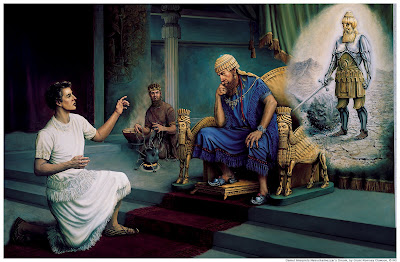
Reflection Five: I feel that we have a glorious future, as a people, but we are starting to forget it. The Book of Daniel (Chapter 2:44-45) holds this amazing prophecy:

“And in the [latter] days... shall the God of heaven set up a kingdom, which shall never be destroyed: and the kingdom shall not be left to other people, but it shall break in pieces and consume all [other] kingdoms, and it shall stand for ever.
Daniel prophesied the Church's triumph
in the last days, thousands of years ago.

“Forasmuch as thou sawest that the stone was cut out of the mountain without hands, and that it brake in pieces the iron, the brass, the clay, the silver, and the gold; the great God hath made known to the king what shall come to pass hereafter: and the dream is certain, and the interpretation thereof sure.”

As Church members, we know that this prophecy refers to the latter day Church and Kingdom of God, restored to the Earth for the last time. I fear, though, that most of us have mostly forgotten this, and see the Church basically as a social club, or less. Too many times, I've seen the speaker get up in sacrament meeting, apologize for not having prepared his remarks until the night before, and start droning into his notes for the next fifteen minutes, while the rest of the congregation mentally checks out and struggles to stay awake. Too often, we let ourselves believe, unconsciously, that that's all the Church is really all about.

But isn't our destiny greater than all that? 

Sunday, February 2, 2014

Mormonism and Biology - A Likely Alliance

Genetic research has been a tremendous boon to science and medicine over the last several decades. It has allowed us to pinpoint exact genetic causes of diseases that for hundreds or thousands of years had been mysteries to science. It has allowed us to develop drugs that improve, save, and prolong life around the world. Genetic research has allowed us to map the human genome, predict dangerous tumors a long way off, and is even beginning to allow us to show a genetic basis for many important personality traits.

But in order to do genetic research, you need to get quite a few things right. It's very technology intensive, and it's almost like putting together a puzzle. If you remember from high school biology, recessive genes will hide themselves in a person's genome, only manifesting themselves once every several generations. It's like sleuthing out a mystery, where the culprit can hide himself for generations.

The Mormon Church and Mormon culture in Utah have been a tremendous boon to the process of human genetic research. Why? Mormons' culture and theology have given them most of the puzzle pieces, allowing one university researcher to proudly declare that “more human disease genes have been discovered in Utah than in any other place in the world.”
  • Mormons place a huge emphasis on family history research, and that is the first piece of the puzzle. If you track down one person who has a strange disease, you might be able – with a lot of work, and some blind luck – to determine the individual gene or set of genes that leads to it. But your chances for success are greatly multiplied if you can find their brothers and sisters, aunts and uncles, first and second and fifth cousins. Once you've found a family, you can see if any of their relatives have the same disease, and if they do, you're in luck: you can test them for the gene or group of genes that you think is responsible for the disease, and if they all have it, you've made a discovery! And if not,
    The LDS Church's Family History Library - over
    8 billion records are housed in this building.
    you know you have to go back to the drawing board.
    Mormons literally see family history work as their God-given duty, and have traced back family trees that stretch back sometimes four and five hundred years, complete with aunts, uncles, cousins, and multiple-wives. The Church's Family History Library, in downtown Salt Lake City, Utah, has more than 8 billion names in it: that's more names than there are people alive today!
  • Mormons have huge families. Recessive genes aren't manifested in every generation – and the genetic diseases that these researchers are looking for are overwhelmingly recessive. You need a big family tree to find some of these genes in families, and the bigger, the better. Basically, if you double the size of the family, you double the chances that the gene you are looking for will pop up. Also, Mormon families, which typically end in divorce less often, have fewer step- or half- relatives, which keeps things nice and simple for researchers. (As an aside, not even the widespread practice of polygamy in Mormon circles – leading to half-families – is slowing things down too much. Only about 30 percent of Utah families were polygamous, even at polygamy's height.)
  • Mormons live clean, homogenous lifestyles. Being a card-carrying Mormon means no alcohol, no tobacco, and no drugs. Also, they typically eat pretty similar diets, and lead pretty similar lifestyles. This helps geneticists understand more easily when a disease is caused by genetic factors, and when it is caused by environmental factors. In other, more scientific terms, it helps them control for environmental factors in determining the effects of genetics on diseases.
  • The spread of a cancer genetic mutation that
    was tracked with the help of Mormon family history.
    Mormons are also genetically more homogeneous than other groups of people. Ok, laugh if you want about Mormons in Utah being just a bunch of white guys – it's actually statistically pretty true. In fact, most Mormons can trace their ancestry to one of just a handful of Western European countries. But when it comes to doing genetics research, that's a great boon, because it allows researchers to control for many more genetic factors. When they're obtaining massive samples of people who all came from a relatively small gene pool, progress can multiply.
  • Mormons cooperate with the geneticists. None of this would mean anything if Mormons were uncooperative or guarded, and the researchers couldn't make progress on a social front. But quite the opposite is true. At family reunions, sometimes with thousands of people, geneticists have been known to set up booths to ask for blood samples, and have family members “eagerly sign consent forms and give blood samples.” Likewise, they are cooperative with geneticists who ask for family history records. Since at least the 1970's, the LDS Family History Library has contributed extensively to genetic research, forming the backbone of what is called the “Utah Population Database,” a Big-Data database of 7.3 million individuals who were born, married, or died in Utah.

  • A family history tree showing the
    incidence of a recessive genetic disease.
    In Utah, science doesn't merely exist. It prospers.” Mormons understand the importance of science, and have put significant amounts of time and money into genetics, usually indirectly, but sometimes directly as well. Dr. John Kauwe, of LDS Church-owned Brigham Young University, has been doing some very significant research on genetics and its role in Alzheimer's disease. In recent years, he's gone to Cache Valley, Utah, where they've found a specific gene which may slow Alzheimer's disease from progressing. Because of extensive family history research, Dr. Kauwe and his team were able to narrow their focus to a very specific set of just a few families living in Cache Valley, instead of having to test large segments of the population for the gene. Since then, he has succeeded in identifying a gene – a variant of the TREM 2 gene – which increases a person's risk of Alzheimer's between two and six times.(Source) To pinpoint that exact gene, he and his colleagues had to sift through 5 terabytes - 5,000 gigabytes - of genetic information. Even though it doesn't say so in the article, you can take it to the bank that a tremendous amount of that information was from Utah natives.
I know that a lot has been said recently about science and religion not getting along. Nowadays, the world's loudest atheist is a biologist by profession, and you'd think that they won't ever make nice between each other. But the way I see it, Mormonism and biology are already getting along great, if only so far in a practical sense. In the real world, where the rubber hits the road, the world of big-data bioinformatics and the world of LDS culture are coming together and complementing each other. It was, in hindsight, quite a likely alliance.


(Unless otherwise noted, all quotations are taken from http://learn.genetics.utah.edu/content/science/utah/, a website I highly recommend for anyone seeking to learn more. All information on this blog posting has come either from websites already cited, my own personal experiences, and/or personal discussions with my biology professor, Dr. Richard Gill, at BYU.)

Wednesday, January 29, 2014

"Turn to the Lord"

After a series of events in these last few weeks, I've learned some valuable lessons. I've learned more about myself, and more about the God which I worship. It's been a very positive and happy experience overall, to say the least. It was also unexpected. To understand, I'll give you some background detail.

I had been working at a job since just after Trevor and I were married. It was a part time job, then quickly went to full time. I am a full time college student attending an online university (WGU), and studying accounting. In the last few weeks, I just hit my core accounting classes. For the previous 2 years, I had been able to skate through college, now, I just can't do that. While I was working, I was doing homework from 7 am - 9:30 am. This was about enough time for me to read a chapter. After work, I just didn't have time to do any homework.

The end of my term was coming up, less than 6 weeks. I still had 2 accounting classes to do. If I didn't pass both classes, I faced the chance of losing my half tuition scholarship. I took my pre-assessment for my first class and failed miserably, by 30 points.

That's where everything started. It hit me like a ton of bricks, that something had to change, something had to give. My dilemma make me think all weekend. I studied my degree plan and my classes. I pondered and prayed all weekend on what I needed to change.

I came to the conclusion that I had to ask for less time. I had to go part time. I am a college student. I'm not 30 or 40 something trying to go back to school to finish my degree. I am 20 and am trying to do the "correct" path the first time and just get the stinkin thing done with! Besides, this is the fun time in life where we get to take risks, knowing we are young enough to recover from just about anything. I found it difficult to believe that if billions of other students can go to a traditional university, do school and a little bit of work and be ok, and totally normal. Why can't I do the same thing??

So, Sunday night, I was still worried if I was doing the right thing, but I saw no other option. It had to be this way. Trevor and I had talked all weekend about my decision, he was just fine with my decision and we made it together. Right before bed, I felt strongly prompted to ask Trevor for a blessing. So, I did.

Trevor has given me 2 blessings now, and they have both been amazing and beautiful. The spirit is always so strong. In the blessing, he said that God loves me and that my decision has been made with the spirit of the Lord. (so, basically, I got God's approval). In both blessings I've been given, it's been said that the outcome of the situation is not know to us. This is because our decisions and actions might change, had we known the outcome, or certain conversations will be of value to the situation, and in the end, we have to grow from the trial/challenge. If we knew all the answers, where would the personal and spiritual growth be??

Near the end, he also reminded/told me that nothing is too small to take to the Lord. (I was nervous to ask for a blessing, because I didn't know if this was a "big enough of a deal" to ask for one.) In fact, He wants us to go to Him. That night, I learned a little bit more of what it meant to "turn to the Lord". It was very comforting, and I knew what I had to do. I also knew that I couldn't back down from my decision.

The the rest of the story is very simple. I went in on Monday, I explained I needed less time. They needed someone full time. So I zigged and they zagged. We parted ways. Walking out of that building for the last time, I had a huge smile on my face. It wasn't the outcome I was expecting, but as soon as everything was said and done, I knew it was the right one. Now, I'm studying school full time and it's very likely I could graduate this year, instead of another 24 months! :) (Maybe kids this year....?)

That's my story in a nutshell, now let me explain the lessons I learned.

1. If you live righteously, you'll have the spirit of the Lord with you to make big decisions.
       Looking back, I can now clearly see that my decision was made with the help of the Spirit.

2. Nothing is too small to take to God, no worry or need is to small to ask for a blessing. The priesthood is something God has given to righteous men to bless His children.
     This is something I'm so grateful for. There is a spiritual protection that comes from having the Priesthood in your home. It's also a huge source of comfort. The words spoken in a priesthood blessing come directly from God.

3. Life rarely goes "according to plan".
     Trevor and I had a 1 year, 2, year and a 5 year plan. It was all based on me working and bringing in money. Now, we get to change our plans, to an even better one.

4. God knows better than we do what we need. He also knows us better than we know ourselves.
        Only He knew how the whole situation was going to play out. If I had known before hand, I wouldn't have gone through with it. Job = security. No job = adventure?? Hahaha.

5. Sometimes, the worst case scenario, really isn't that bad.
       I think that sometime we psych ourselves out about that "worst case". Right now, what is the worst thing that can happen, if I don't have a job? We take out a loan. We don't want to, but that's the worst that can happen...really not that bad.

6.  We are young, and should live life adventurously.
        When I came home and told Trevor I parted ways with my job, he was surprised and nervous. But hey, we are young. Let's live adventurously (but still be smart about it.)

7. We are young and can recover from just about anything.
       I'm getting a degree in accounting, Trevor is getting a degree in civil engineering. We are young, and will be leaving school with 2 very good degrees. We can recover from just about anything.

8. Sometimes, God really gives us what we want, even when we think we couldn't have it, nor did we think it was an option.
       Deep down, I didn't want to work. I didn't like my job a whole lot. (Customer service is no fun). All I wanted was to do school full time, just like EVERYBODY else in Provo. But I just didn't see that as an option. So I never considered parting ways with my job (which is what I wanted deep down). God gave me what I wanted, even though I didn't think it was an option. :)

9. If you're not happy, then change it.
       This is something I've known for a while. If you're not happy, change it. Happiness is mostly a choice. Some dire situations really do just stink and can't be changed, but change your situation or attitude to be happy. Life is to short to be miserable. 

10. God has a sense of humor. I'll leave it at that. 

11. Life isn't suppose to be easy. God gives us trials and challenges to learn from them. If we knew how every situation would turn out, how would we learn or grow? 


So, 3 weeks down the road, where am I? Any minute now, I could be approved to take my pretest again, (remember the one I failed 30 points on?). After I pass this one, I can take the real test and be done with it! YAY! In the next 30 days I'll have my second class done and pass all my classes this term. Life has been so much better from this whole experience and I'm super grateful for it. I've learned valuable lessons and have been able to draw closer to God from this experience. Life is good. :)

- SamiMae

Sunday, January 26, 2014

9 Mind-Blowing Facts About the LDS Conference Center

In just less than a week, my last blog post, “5 Reasons Mormonism is Actually Kinda Cool,” got way more pageviews than I was expecting (150+ and counting!), and a share on Facebook.

That's really cool. So, thanks, guys.

As a way of showing my gratitude, here's another! Hopefully this one will interest and amaze you even more. May I present:

9 Mind-Blowing Facts About the LDS Conference Center:

First, some background: The Conference Center is the world's largest indoor amphitheater ever constructed. Announced in 1996 by then-President of the LDS Church, Gordon Hinckley, it had an ambitious schedule for design, planning, and construction. Hinckley asked that it be ready by the first General Conference of the new millennium, in April 2000. (A General Conference, in Mormon parlance, is a biannual general meeting of the Church, where we listen to our leaders impart spiritual guidance, Church business is discussed, and announcements that affect the entire Church are made.) The new Conference Center is used to host General Conferences twice a year, as well as cultural performances and community events year-round.
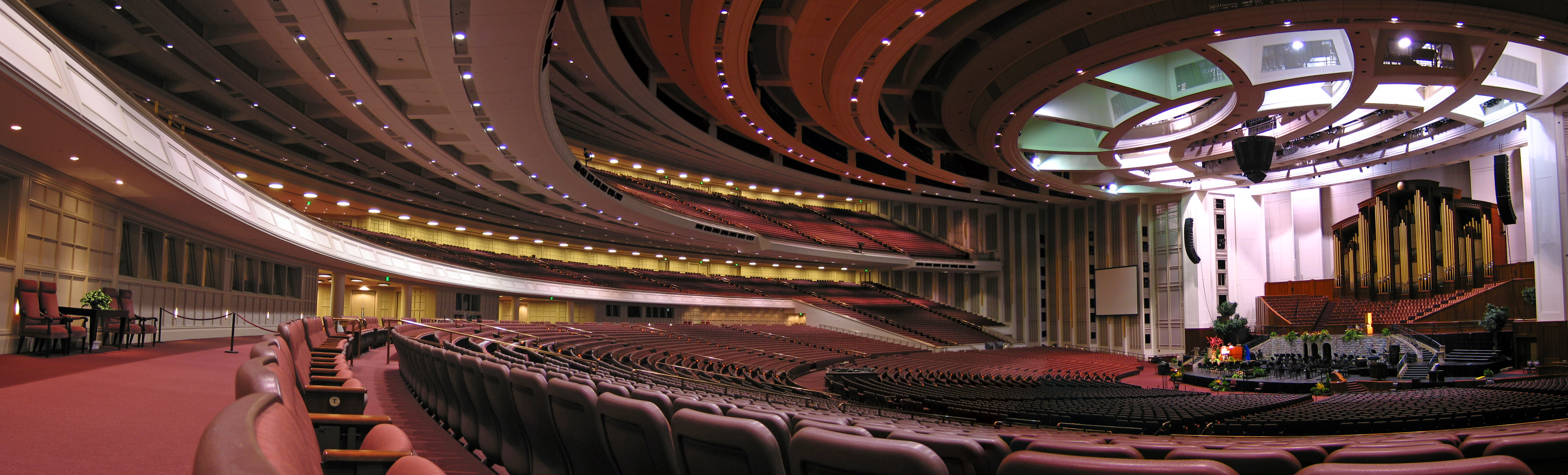
A panoramic view of the main Assembly Hall of the Conference Center. (Source: Wikipedia.)

The scope of this building is tremendous – it takes up an entire 120-acre city block. On the top of the roof, there is an entire garden: three acres of grass and hundreds of trees dot sloped terraces. An honest-to-goodness river crosses the roof before descending 67 feet along the side of the building in a waterfall. In the main assembly hall, it seats 21,000. You could fit an entire Boeing 747 comfortably in there. (Wikipedia says you could fit two, but that's not sourced, so I dunno...)

So, with that in mind, here are the nine most amazing facts that I could come up with about it, in no particular order.
  1. The construction team and schedule were unprecedented. Three local construction companies – Okland, Jacobsen, and Layton – submitted a joint bid, and called their joint team “Legacy Constructors.” Why? Because any one of them simply didn't have the manpower to get the job done, and they wanted to compete for the job with the national firms. When they won the bid, they only had 17 months to go from groundbreaking to substantial completion. “On any given day during the height of construction, as many as 1,000 workers were on site.” Source
  2. The teleprompter is wicked cool. The custom-designed teleprompter displays words ONLY to the folks who are directly at the pulpit. I actually had a physics class from Dr. Justin Peatross, one of the guys who designed  this thing, where he described it to us. By cutting a Fresnel lens in half, he was able to use the principles of optics and light waves to  create a projector that focused the teleprompter's words exactly on the podium. Not to the left, or to the right, but right there. Someone who's even a few feet to one side of the podium won't see what the telepromptor is saying.
  3. There are 116,000 total cubic yards of concrete found in the Conference Center. That's almost twice the amount used in constructing the Empire State Building, or enough to fill an entire football field to a depth of almost two stories.
  4. There are over 27,000 tons of steel in the building also. That's just massive. There are no interior columns, so all the seats have an unobstructed view of the pulpit. This is done through use of massive truss beams that extend from the back of the assembly hall to it's main, “King” truss at the front. From there, the weight is taken down two massive concrete columns into the ground.
    The demand on these trusses is made even greater because there is tremendous weight on the roof from the landscaping, gardens, and river on top of the building. In some places, the roof loads surpass 500 pounds per square foot – more than five times the weight on most other roofs.
  5. The King Truss is beyond big. In order to build a truss that was big enough to support the enormous loads (millions of pounds) that are weighing down on it, they couldn't find a normal piece of steel thick enough. Instead, they welded two of the largest steel shapes they could find, back-to-back, just to get it strong enough. It is 152 feet long and weighs 621 tons.
    Yes, this is the King Truss. And yes, those are people standing on top.
    And just think: this thing is directly above the podium where all the Mormon leaders speak twice a year. Better hope the engineers ran the calculations on that thing right!
  6. The Conference Center is designed to last at least 150 years. That was a tall order, especially since Salt Lake City is right in the middle of a seismic zone. They had to go above and beyond the requirements of normal seismic building code (which is based on withstanding the largest earthquake in 75 years or so) to make sure that it could withstand the largest earthquake that would occur in 150 years.
  7. Most of the actual building, including the podium, is underground. The architects couldn't go above 75 feet above ground because of local zoning restrictions. This created huge engineering challenges, because the walls had to withstand the tremendous weight of all the dirt pushing against them, trying to cave them in. Some of the walls in the deepest part of the building (the parking garage) are made of concrete up to 14 inches thick!
  8. The pipe organ is a masterpiece. It is composed of 7,667 individual pipes, and was designed and built by Schoenstein & Co., the oldest and largest organ builder in the Western United States. It's so big and complex, it wasn't ready for use until three years after the Conference Center was completed. This thing is massive, and sounds absolutely beautiful in real life.
    The Conference Center organ is a true work of art.
  9. The acoustics are mind-bogglingly complex, and yet beautiful. Imagine trying to build an auditorium this large and complex, with its  many and varied uses, flat walls, microphones and speakers out your eyeballs, and get anything besides endless feedback and echoes. A pretty tall order, but one that has been pulled off admirably. During Conference, you can always hear a little bit of echo, but overall the building can adapt very well to varied and seemingly contradictory acoustical demands. “Careful calculation was necessary to place loudspeakers precisely to compensate for a sound lag ... caused by the relatively slow speed of sound vibrations in air.” Source.
There you go. I love this building more every time I think about it, and I hope you've enjoyed reading this blog as much as I've enjoyed writing it. I'm always impressed and thankful for everyone reading these things. It's a joy to be able to spend a little bit of time every week sharing little-known or less-discussed aspects of my church and my faith with others, and I'm glad you guys are willing to come and read. I think I'm going to make this a regular thing, posting here every week or so.

So, I want your opinion on where to take it. Next week, would you rather read about “7 Interesting Mormon Beliefs You May Not Have Heard Of,” or “5 Things You Should Do The First Time You Attend a Mormon Worship Service”? Or, maybe you'd rather heard about something else entirely. Write a comment, and whichever idea has the most support will get it's own blog next week.

Sunday, January 19, 2014

5 Reasons Why Mormonism Is Actually Kinda Cool!


5 Reasons Why Mormonism Is Actually Kinda Cool!


Alex Boye is a Mormon, and has sung with
N' SYNC and the Backstreet Boys
I think that Mormonism has a reputation for being a church of conformists run by stodgy old white guys. Granted, there are limits to what we legitimately should or should not do that not a lot of other non-Christians live by. And even amongst fellow Christians, we've gotten some raised eyebrows (no coffee?!?!?! I'll never live!!!). But it's actually kind of a cool place, as long as you're OK with wholesome fun.

So in no particular order, here are 5 reasons that Mormonism is a fun, cool experience:
  1. Man, are we ever full of musicians, actors, athletes, you name it. Check out famousmormons.net if you don't believe me. There are the well-known ones, of course: Jon Heder (Napoleon Dynamite), Lindsey Stirling (rock-violin chick), David Archuleta (came in 2nd on American Idol), and Brandon Flowers (lead singer for The Killers), the entire band “Imagine Dragons,” etc. etc. etc. But there are also less-known Mormon celebrities that you may have never heard of. For instance, did you know that one of silent film's greatest celebrities, John Gilbert, was Mormon? He was ranked 28 in the top 100 most influential people in the history of film. Or, that Alex Boye sang alongside N'SYNC and the Backstreet Boys? True stories. How about this – that the inventor of television, Philo Farnsworth, was a Mormon who lived in little Rigby, Idaho? Or that the inventor of the Ruby programming language - Yukihiro Matsumoto – is an active member of the Church also?
    Also, there are plenty of once-Mormon or lapsed Mormon celebrities. I think my favorites are Aaron Eckhart (Two-Face on “The Dark Knight”), Paul Walker (R.I.P. - From “The Fast and the Furious” series), and Amy Adams (The Princess on “Enchanted.”)
  2. We've got some pretty fun traditions. They range from the well-known to the hilariously obscure. I mean, anyone can go visit the lights on Temple Square around Christmastime, but who hasn't wanted to go on a “Brigham Date”? Popular at the Church-sponsored Brigham Young University, a Brigham Date is where one or two guys will take four or five girls out at once. And yes, I get it, it is tongue-in-cheek. We can laugh about that stuff, too, you know.
    If you're trying for something more down low, though, try the annual ward Christmas Party, where a local geographic congregation gets together to hang out, make lasting friendships, and eat good food. Don't expect to see booze or skanky girls at this “party,” but it really is fun, in a good, clean, wholesome way.
  3. Joseph Smith was a pretty cool guy, though
    Mormon history has covered that up a lot.
    Our first prophet, Joseph Smith, was quite a rabble-rouser. Nowadays in Sunday school, we get the impression that he was a priestly, almost stogy character, but nothing could be further from the truth. He was innovative, impressive, charismatic, and kept absolutely everybody on their toes. (A small example: mission calls used to be read from the General Conference pulpit... with no advance notice to those who would be called!) Although you'd be hard-pressed to find such an adventuresome spirit in the Church nowadays, Joseph the Prophet was actually pretty rad.
  4. Mormons take create a family atmosphere that nurtures fun recreational activities. Every Monday night, Mormon faithful gather in families to play games, sing songs, shoot the breeze, and generally enjoy each other's company. What exactly happens at these “family home evenings” depends entirely on the family, their own preferences and interests, and how they're feeling on any particular night. Couples also work to regularly go on dates and keep the flame alive, whether married or just dating. I personally have known middle-aged and older couples who still make it a point to date each other every week. I'm actually very impressed.
  5. Mormons get technology. Whether it's the work of BYU animators who are being recognized for their creation of good, clean fun films (http://www.nytimes.com/2013/05/26/magazine/when-hollywood-wants-good-clean-fun-it-goes-to-mormon-country.html?pagewanted=all), to the proponderance of Mormons who gravitate towards Pinterest, to Mormons who come up with good-natured memes all over the place (Examples: search Youtube for “Tom Cruise on Home Teaching,” or “Book of Mormon Style” will know what I'm talking about. Or a quick Google Images search for “Uchtdorf memes,” “Jeffrey R. Holland memes,” or “Hey Girl Mormon Memes.”), you'll find us hanging out, chatting, and just enjoying ourselves online.
A screenshot from "Estefan," a Student-Emmy
winning animation put together by BYU students.
Well, there you have it. Five reasons why Mormonism is kinda fun, kinda cool. I echo the words of early Mormon leader Heber C. Kimball, who asserted, “I am perfectly satisfied that my Father and my god is a cheerful, pleasant, lively, and good-natured Being. Why? Because I am cheerful, pleasant, lively and good-natured when I have His Spirit.” I know I've felt that Spirit when I've been in Church and with others of my faith.